

YUNOVA Stories · Money & Finance
Amartya Sen: from Santiniketan to the Nobel, economics for human welfare
Amartya Sen · Economist and philosopher, 1998 Nobel laureate in economic sciences
Written by YUNOVA from public sources. Amartya Sen is not affiliated with and does not endorse YUNOVA.यह कहानी YUNOVA ने public sources से लिखी है। इसमें बताए गए व्यक्ति YUNOVA से जुड़े नहीं हैं और YUNOVA का समर्थन नहीं करते।
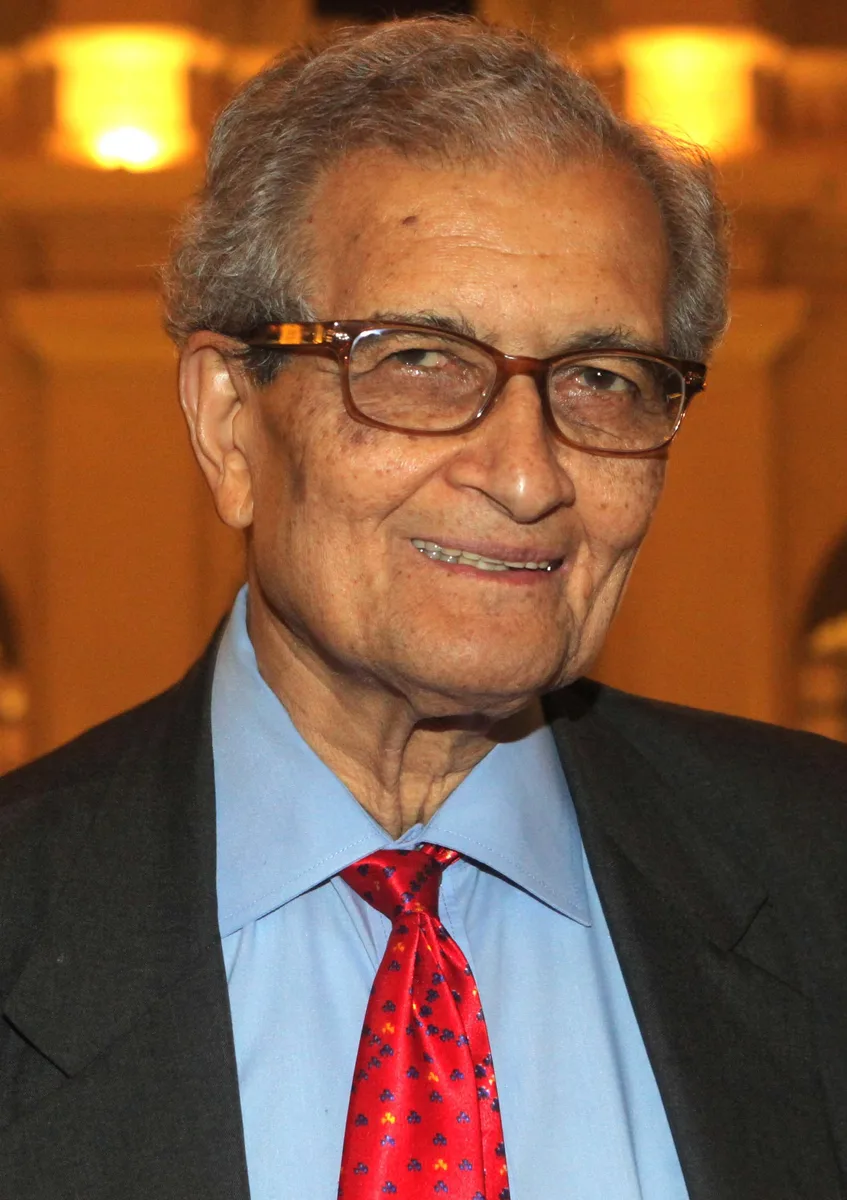
Amartya Sen was born on a university campus in Santiniketan in 1933 and, by his own account, has lived on one campus or another ever since. A famine he saw as a boy and questions he argued over as a student in Calcutta became the work of his life. In 1998 he received the Nobel prize in economic sciences for his contributions to welfare economics. His story shows economics as a tool for understanding how people actually live.
A school that valued curiosity
Sen was born in 1933 in Santiniketan, on the campus of Rabindranath Tagore's Visva-Bharati, where his grandfather Kshiti Mohan Sen taught Sanskrit and Indian culture. His family came from Dhaka, where his father Ashutosh Sen taught chemistry at Dhaka University. He spent three early years in Mandalay, Burma, and much of his childhood in Dhaka, before moving to study at Tagore's school.
In his Nobel autobiography he writes that the school encouraged curiosity rather than competition, and that interest in exam grades was firmly discouraged. Between the ages of three and seventeen his chosen subject changed from Sanskrit to mathematics to physics before he settled on economics.
Two experiences from those years stayed with him. From Santiniketan he watched the Bengal famine of 1943, in which two to three million people died, and noticed that it struck only the poorest, such as landless rural labourers. In Dhaka he saw a Muslim daily labourer, Kader Mia, who had been knifed during communal riots after going out to look for work because his family had nothing to eat. Sen writes that the experience was devastating for him.
“I was born in a University campus and seem to have lived all my life in one campus or another.”
— Amartya Sen, via NobelPrize.org
Calcutta, Cambridge and Delhi
He studied at Presidency College in Calcutta from 1951 to 1953, taking a B.A. with economics as his major and mathematics as his minor. In early 1952, at eighteen, he was treated for cancer of the mouth with heavy radiation. He recovered and kept studying.
In 1953 he went to Trinity College, Cambridge, which enrolled him for a second B.A. because he was still in his late teens. He received his doctorate from Cambridge in 1959. Before he turned 23 he was asked to set up a new economics department at Jadavpur University in Calcutta. A Prize Fellowship at Trinity then gave him four years of freedom, and he used them to study philosophy.
From 1963 to 1971 he was a professor at the Delhi School of Economics. There he worked deeply on social choice theory, the study of how the views of many individuals can be combined into fair decisions for a society. His book Collective Choice and Social Welfare appeared in 1970.
Famines, poverty and the Nobel
After Delhi he taught at the London School of Economics, Oxford and later Harvard. From the mid-1970s he worked on the causes and prevention of famine, leading to his 1981 book Poverty and Famines. The Nobel committee explains that he challenged the view that a shortage of food is the main cause of famine, showing that famines had occurred even when food supply was not much lower than usual. What mattered was whether different groups of people could actually buy or obtain food.
He also helped his old friend Mahbub ul Haq develop the United Nations' Human Development Reports, which take a broader view of development than income alone.
On 14 October 1998 the Royal Swedish Academy of Sciences awarded him the prize in economic sciences for his contributions to welfare economics. It said that, by combining tools from economics and philosophy, he had restored an ethical dimension to the discussion of vital economic problems. That year he became Master of Trinity College, Cambridge.
The skills and habits that made the difference
The first was asking questions from life. In his autobiography he links the famine he saw, and the labourer who died after going out to find work, to the questions about poverty and deprivation that he went on to study.
The second was building strong tools. He studied mathematics alongside economics in Calcutta, and his work on social choice draws heavily on mathematical logic, so that ideas about fairness could be examined precisely.
The third was learning across subjects. He spent his fellowship years on philosophy, and the Nobel committee pointed to exactly that combination of economics and philosophy as central to his contribution.
What you can learn from Amartya Senइस कहानी से आप क्या सीख सकते हैं
- Start from the world around youSen's work grew from a famine he saw as a boy. When you learn a concept like demand, prices or income, look for where it shows up in your own town and your own household.
- Do not skip the mathematicsHe paired economics with mathematics from his first degree. Graphs, percentages and basic algebra are what let you check an economic idea instead of only repeating it.
- Ask who gains and who losesHis famine research showed that the same event affects different groups very differently. Whenever you study a price change or a policy, ask how it affects the poorest people, not only the average.
- Read beyond your subjectHe studied philosophy for four years after his economics training, and it shaped his later work. History, politics and ethics all help you understand why economic questions matter.
How you can build this skill on YUNOVAYUNOVA पर आप यह skill कैसे सीख सकते हैं
Nobody becomes Amartya Sen from one course. But his questions about prices, poverty and welfare start from ideas every economics learner meets in the first chapters. YUNOVA's Economics skill helps you build those foundations step by step, for free, in Hindi.

हिंदी में सारांश
अमर्त्य सेन का जन्म 1933 में शांतिनिकेतन में हुआ, जहाँ टैगोर के स्कूल ने उनमें जिज्ञासा जगाई। बचपन में उन्होंने 1943 का बंगाल अकाल देखा, और ऐसे अनुभव आगे उनके काम का आधार बने। कलकत्ता और कैम्ब्रिज में पढ़ाई के बाद उन्होंने ग़रीबी, अकाल और कल्याण पर शोध किया। 1998 में उन्हें welfare economics के लिए अर्थशास्त्र का Nobel पुरस्कार मिला। आप भी YUNOVA पर Economics skill हिंदी में मुफ़्त शुरू कर सकते हैं।
Sourcesस्रोत
- Amartya Sen – Biographical, NobelPrize.org (accessed 18 October 2026)
- The Prize in Economic Sciences 1998 – Press release, Royal Swedish Academy of Sciences (NobelPrize.org) (accessed 18 October 2026)
- Amartya Sen (Research Starters), EBSCO (accessed 18 October 2026)
- Amartya Sen, Wikipedia (accessed 18 October 2026)
Written by YUNOVA from public sources. Amartya Sen is not affiliated with and does not endorse YUNOVA.
More storiesऔर कहानियाँ
- Andrew Ng: the professor who put machine learning online for everyoneCo-founder of Coursera and founding lead of Google Brain
- Andy Jassy: the marketing manager who built Amazon Web ServicesFounding leader of Amazon Web Services and Amazon's CEO
- B. R. Ambedkar: the scholar who chaired the drafting of India's ConstitutionJurist, economist, social reformer and chairman of the Drafting Committee of the Constitution of India