YUNOVA Stories · Study
Kalpana Chawla: from a school in Karnal to space
Kalpana Chawla · Aerospace engineer and NASA astronaut
Written by YUNOVA from public sources. Kalpana Chawla is not affiliated with and does not endorse YUNOVA.यह कहानी YUNOVA ने public sources से लिखी है। इसमें बताए गए व्यक्ति YUNOVA से जुड़े नहीं हैं और YUNOVA का समर्थन नहीं करते।
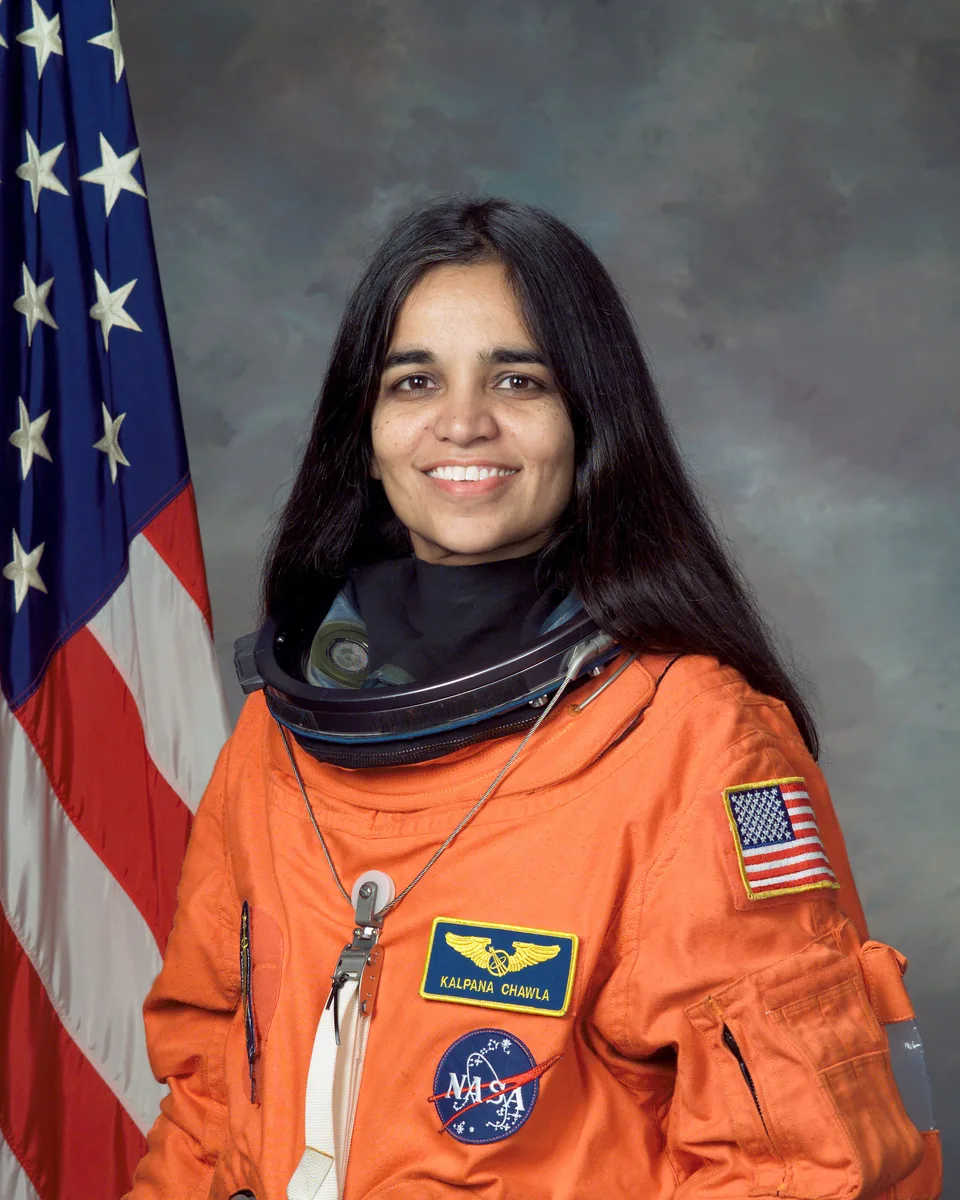
Kalpana Chawla finished school in Karnal, Haryana, in 1976. Two decades later she flew on the Space Shuttle Columbia, the first woman of Indian descent to go to space. Her path ran through engineering college, years of research and a long list of pilot licences, one step at a time.
A school in Karnal and an engineering degree
Kalpana Chawla was born in Karnal, in present-day Haryana, in 1962. She studied at Tagore Baal Niketan school in Karnal and completed her schooling there in 1976.
She then joined Punjab Engineering College in Chandigarh and chose aeronautical engineering, the study of aircraft. She earned her bachelor's degree in 1982. That same year she moved to the United States for higher studies.
She kept her link with her old school. On her first space flight in 1997, she carried a T-shirt from Tagore Baal Niketan with her picture printed on it.
Higher studies and research on air flow
In the US she completed a master's degree in aerospace engineering from the University of Texas in 1984. Then she went to the University of Colorado Boulder, where she earned a PhD in aerospace engineering in 1988, guided by Professor C. Y. Chow.
In 1988 she started work at NASA's Ames Research Center in California. Her field was computational fluid dynamics, which means using computers to calculate how air moves. She simulated the complex air flows around aircraft such as the Harrier jet when they fly close to the ground. Later she helped adapt these flow programs to run on parallel computers.
In 1993 she joined Overset Methods Inc. in Los Altos, California, as vice president and research scientist. There she worked on methods for aerodynamic optimisation, which is finding the best shape for something that moves through air. She became a US citizen in 1991. Her research results appeared in technical conference papers and journals.
Selected as an astronaut
NASA selected Kalpana Chawla in December 1994. In March 1995 she reported to the Johnson Space Center in Houston as an astronaut candidate in NASA's 15th group of astronauts.
Training lasted a year. After that, she worked on technical problems for the astronaut office. Her tasks included developing displays that help astronauts operate robotic arms, and testing space shuttle control software in a special laboratory.
In November 1996 she was assigned to her first mission, STS-87, as a mission specialist and the prime robotic arm operator.
Two flights on Columbia
STS-87 flew on the Space Shuttle Columbia from 19 November to 5 December 1997. The crew ran experiments on how weightlessness affects physical processes and observed the outer layers of the Sun's atmosphere. The shuttle circled the Earth 252 times and travelled about 6.5 million miles. With this flight, Kalpana Chawla became the first woman of Indian descent to go to space.
Her second mission, STS-107, launched on 16 January 2003. It was a 16-day science mission. The crew worked in two shifts around the clock and completed about 80 experiments.
On 1 February 2003, Columbia broke apart during its return, 16 minutes before its planned landing. Kalpana Chawla and her six crewmates lost their lives. Across her two flights she had spent 30 days, 14 hours and 54 minutes in space. She was posthumously awarded the Congressional Space Medal of Honor, and in 2020 a cargo spacecraft to the International Space Station was named S.S. Kalpana Chawla in her memory.
The skills and habits that made the difference
Flying was not only her job. NASA's biography records that she enjoyed flying, hiking, backpacking and reading. She held a certified flight instructor's licence, commercial pilot licences for land planes, seaplanes and gliders, and an instrument rating. She also enjoyed flying aerobatics.
Her work was built on strong maths and physics. Computational fluid dynamics turns the laws of physics into equations and then solves them with computers. She spent about six years on this kind of research, at NASA Ames and then at Overset Methods, before she was selected as an astronaut.
She also helped students who came after her. According to her school, she asked NASA to invite Tagore Baal Niketan to a summer space programme in Houston. From 1998, students from India visited every summer, and she hosted them for dinner at her home with Indian food she cooked herself.
What you can learn from Kalpana Chawlaइस कहानी से आप क्या सीख सकते हैं
- Build strong basics firstKalpana Chawla's research used physics and maths every day. The topics you study for engineering entrance exams are the same foundation she built on.
- Take one step at a timeSchool in Karnal, a degree in Chandigarh, a master's, a PhD, research work and then NASA. Each step took years, and each one opened the next door.
- Keep learning outside classShe earned several pilot licences alongside her main work. Learning a skill you enjoy, beyond your syllabus, can deepen your understanding of your main subject.
- Help the people coming after youShe made sure students from her old school got a chance to visit NASA. When you learn something, share it with your juniors.
How you can build this skill on YUNOVAYUNOVA पर आप यह skill कैसे सीख सकते हैं
Nobody becomes Kalpana Chawla from one course. But the physics, chemistry and maths she relied on are the same subjects every engineering aspirant starts with, and you can study them for free on YUNOVA's JEE Main path. If the stars and planets interest you, the astronomy course is a good place to begin.
हिंदी में सारांश
कल्पना चावला का जन्म 1962 में करनाल, हरियाणा में हुआ था। उन्होंने चंडीगढ़ के Punjab Engineering College से aeronautical engineering पढ़ी और फिर अमेरिका में master's और PhD की। 1994 में NASA ने उन्हें astronaut चुना, और 1997 में वे अंतरिक्ष जाने वाली भारतीय मूल की पहली महिला बनीं। 2003 में Columbia दुर्घटना में उनका निधन हुआ। आप भी physics और maths की मज़बूत नींव से अपनी engineering की तैयारी शुरू कर सकते हैं।
Sourcesस्रोत
- Kalpana Chawla (Ph.D.) NASA Astronaut (Deceased) - Biographical Data, NASA Johnson Space Center (accessed 17 October 2026)
- Spacecraft named for late astronaut and CU Boulder graduate Kalpana Chawla, University of Colorado Boulder (accessed 17 October 2026)
- Kalpana Chawla Story, Tagore Baal Niketan, Karnal (accessed 17 October 2026)
- Two CU-Boulder engineering alums fly NASA space shuttle Nov. 19, University of Colorado Boulder (accessed 17 October 2026)
- Northrop Grumman names NG-14 Cygnus for Columbia astronaut Kalpana Chawla, collectSPACE (accessed 17 October 2026)
- Kalpana Chawla, Wikipedia (accessed 17 October 2026)
Written by YUNOVA from public sources. Kalpana Chawla is not affiliated with and does not endorse YUNOVA.
More storiesऔर कहानियाँ
- Amartya Sen: from Santiniketan to the Nobel, economics for human welfareEconomist and philosopher, 1998 Nobel laureate in economic sciences
- Andrew Ng: the professor who put machine learning online for everyoneCo-founder of Coursera and founding lead of Google Brain
- Andy Jassy: the marketing manager who built Amazon Web ServicesFounding leader of Amazon Web Services and Amazon's CEO