

YUNOVA Stories · Design & Creative
Raghu Rai: the engineer who spent sixty years photographing India
Raghu Rai · Photojournalist, Magnum Photos photographer and Padma Shri awardee
Written by YUNOVA from public sources. Raghu Rai is not affiliated with and does not endorse YUNOVA.यह कहानी YUNOVA ने public sources से लिखी है। इसमें बताए गए व्यक्ति YUNOVA से जुड़े नहीं हैं और YUNOVA का समर्थन नहीं करते।
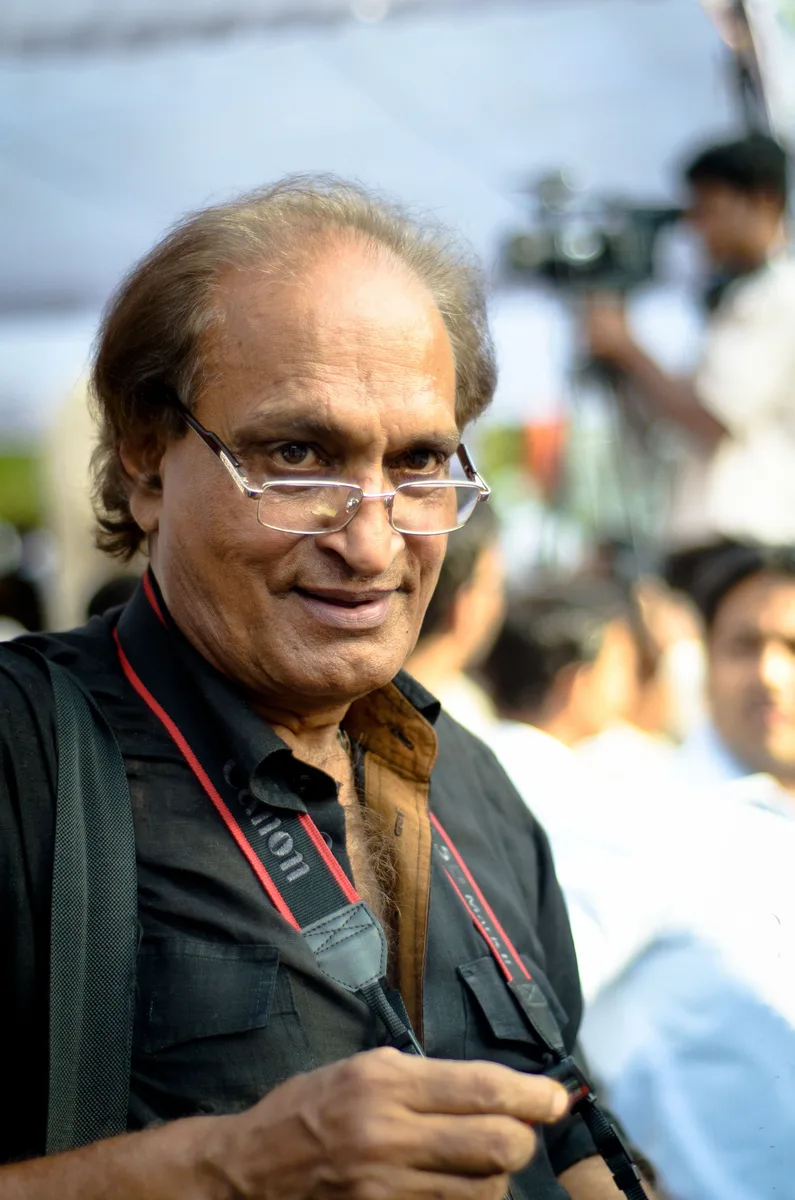
Raghu Rai trained as a civil engineer and picked up a camera in his twenties. Over the next six decades he photographed wars, disasters, leaders and ordinary streets, worked for The Statesman and India Today, and was nominated to Magnum Photos by Henri Cartier-Bresson. His story is a lesson for any photography learner in staying with a subject for years and photographing people from up close.
From engineering to a first published picture
Raghu Rai was born in 1942 in Jhang, a village in Punjab that is now part of Pakistan. PetaPixel gives his date of birth as 18 December 1942. He trained as a civil engineer.
Photography came through family. His brother, the photographer S. Paul, introduced him to the camera during a break in his working life. His first published picture showed a donkey looking straight into the lens, and it appeared in The Times of London.
According to Magnum Photos he took up photography in 1965, when he was about 23, and the following year he joined The Statesman newspaper in Delhi as its chief photographer.
“A photograph has picked up a fact of life, and that fact will live forever.”
— Raghu Rai, via Magnum Photos
Newspapers, magazines and Magnum
He stayed at The Statesman until 1976. His pictures of the 1971 Bangladesh war and its refugees became some of his best-known work, and the Kiran Nadar Museum of Art says he received the Padma Shri in 1972 for that work. Magnum's own profile gives the year as 1971.
An exhibition of his photographs in Paris in the early 1970s caught the eye of Henri Cartier-Bresson, the French photographer famous for candid street pictures. Cartier-Bresson nominated him to Magnum Photos, the photographers' cooperative, and he joined in 1977. The museum describes Cartier-Bresson as a mentor of his early years.
After The Statesman he became picture editor of Sunday, a weekly news magazine published from Calcutta. From 1982 to 1991 he was picture editor, visualiser and photographer at India Today during its formative years, producing picture essays on social, political and cultural themes.
Bhopal, books and a long life with the camera
In December 1984 a gas leak at Bhopal killed thousands of people. Rai's photographs, including the face of a child half buried in the earth, became defining records of the disaster. He did not leave the subject there. Magnum notes that he later completed an in-depth documentary project for Greenpeace on the disaster and its continuing effects on survivors, which became a book and exhibitions that toured from 2004, the twentieth anniversary.
He produced more than 18 books, on Delhi, the Sikhs, Calcutta, Khajuraho, the Taj Mahal, Tibet in exile, Mother Teresa and India itself. His 1992 National Geographic cover story on wildlife management in India was widely praised. He served three times on the jury of the World Press Photo contest. In 2009 France made him an Officier des Arts et des Lettres, and in 2019 he was the first laureate of the Académie des beaux-arts Photography Award.
In 2012 he and his son Nitin, also a photographer, founded the Raghu Rai Center for Photography to pass on what he had learned. He died in Delhi on 26 April 2026, aged 83, after an illness.
The skills and habits that made the difference
The first was staying with a subject. He returned to Bhopal for two decades after the disaster, and the Kiran Nadar Museum of Art describes long-duration projects photographing political and spiritual leaders over many years.
The second was closeness to people. Al Jazeera notes that he photographed India's political and social elite and its ordinary crowds with equal energy, and his best-known portraits, of Mother Teresa and Indira Gandhi, come from being near his subjects again and again.
The third was the daily habit of looking. The museum describes how he photographed India's streets and lanes, walls and bazaars, treating everyday life as live theatre.
The fourth was range. Over his career he worked on film and later digital, in black and white and in colour, and moved between news, portraits, architecture and nature. He also kept learning from other photographers, from Cartier-Bresson early on to the juries he sat on later, and in the end he shared what he knew through his own centre for photography.
What you can learn from Raghu Raiइस कहानी से आप क्या सीख सकते हैं
- Start with what is in front of youHis first published picture was of a donkey. You do not need a famous subject or an expensive camera to begin; photograph your own street, family and market, and learn from every frame.
- Go back to the same placeRai returned to Bhopal years after the disaster. Choose one place near you and photograph it every week. Repeated visits teach you light, timing and the people who live there.
- Get closer to people, with respectHis portraits come from time spent near his subjects. Practise asking permission, talking first and waiting until people relax before you raise the camera.
- Think in stories, not single shotsAt India Today he built picture essays. Try telling a small story in five photographs: a beginning, the people involved, a detail, a moment of action and an ending.
- Show your work and learn from othersAn exhibition brought his pictures to Cartier-Bresson's notice. Share your best photographs, ask for honest feedback, and study the work of photographers you admire to see how they frame a scene.
How you can build this skill on YUNOVAYUNOVA पर आप यह skill कैसे सीख सकते हैं
Nobody becomes Raghu Rai from one course. But the basics he built on, such as light, composition, timing and working with people, can be learned step by step, and YUNOVA's Photography skill teaches them for free, in Hindi, with practice you can do using the camera you already have.
हिंदी में सारांश
रघु राय ने civil engineering की पढ़ाई की थी, लेकिन 1960 के दशक में उन्होंने photography शुरू की। वे The Statesman के chief photographer रहे, बाद में India Today में काम किया और Henri Cartier-Bresson के नामांकन पर Magnum Photos से जुड़े। उन्होंने 1971 के बांग्लादेश युद्ध और 1984 की भोपाल गैस त्रासदी की यादगार तस्वीरें लीं और उन्हें Padma Shri मिला। आप भी YUNOVA पर Photography skill हिंदी में मुफ़्त शुरू कर सकते हैं।
Sourcesस्रोत
- Raghu Rai: Photographer Profile, Magnum Photos (accessed 18 October 2026)
- Raghu Rai: A Thousand Lives, Kiran Nadar Museum of Art (accessed 18 October 2026)
- Raghu Rai, legendary Indian photographer, dies at 83, Al Jazeera (AFP) (accessed 18 October 2026)
- India's Most Celebrated Photographer Raghu Rai Dies, PetaPixel (accessed 18 October 2026)
- Photographer Raghu Rai dies at 83, Scroll.in (accessed 18 October 2026)
- Raghu Rai, World Press Photo (accessed 18 October 2026)
- Raghu Rai, Wikipedia (accessed 18 October 2026)
Written by YUNOVA from public sources. Raghu Rai is not affiliated with and does not endorse YUNOVA.
More storiesऔर कहानियाँ
- Amartya Sen: from Santiniketan to the Nobel, economics for human welfareEconomist and philosopher, 1998 Nobel laureate in economic sciences
- Andrew Ng: the professor who put machine learning online for everyoneCo-founder of Coursera and founding lead of Google Brain
- Andy Jassy: the marketing manager who built Amazon Web ServicesFounding leader of Amazon Web Services and Amazon's CEO