

YUNOVA Stories · Language & Communication
Ruskin Bond: the teenager who wrote a novel and never stopped
Ruskin Bond · Author of The Room on the Roof and more than 500 short stories and essays
Written by YUNOVA from public sources. Ruskin Bond is not affiliated with and does not endorse YUNOVA.यह कहानी YUNOVA ने public sources से लिखी है। इसमें बताए गए व्यक्ति YUNOVA से जुड़े नहीं हैं और YUNOVA का समर्थन नहीं करते।
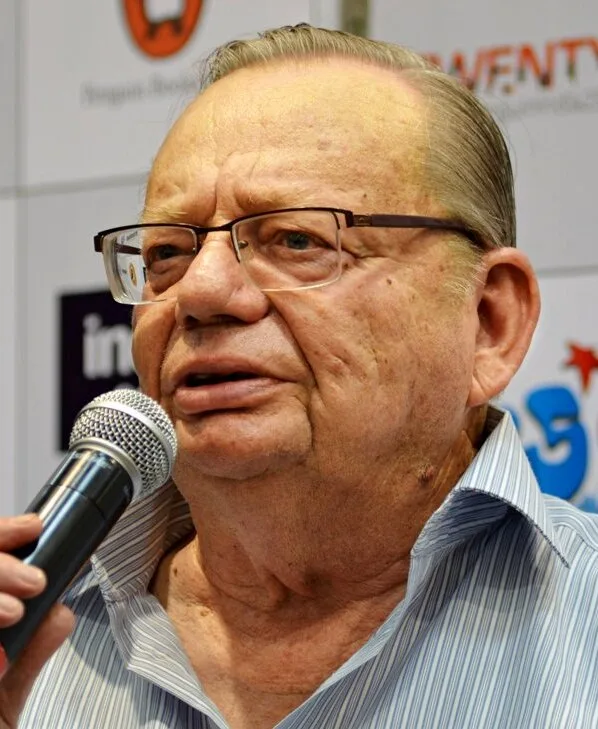
Ruskin Bond started writing his first novel when he was seventeen, far from home in England. That book, The Room on the Roof, won a literary prize, and its author went on to write hundreds of short stories, essays and novellas and dozens of books for children, most of them from a small town in the hills. His story shows what a steady writing habit and plain, honest words can do over a lifetime.
A childhood across India
Ruskin Bond was born in Kasauli, in present-day Himachal Pradesh, in 1934. According to his publisher Penguin, he grew up in Jamnagar, Dehradun, New Delhi and Shimla. The hill towns of his childhood, and especially Dehradun, would later become the setting for much of his writing.
When he finished school, he has said, becoming a writer was not a fashionable choice; writers were known by their names, not their faces, and very few made a living from it.
A first novel at seventeen
After school, Bond spent about four years in the Channel Islands and London. There, at seventeen, he wrote his first novel, The Room on the Roof. It tells the story of Rusty, an orphaned Anglo-Indian boy, and draws on Bond's own teenage years and friends.
The book won the John Llewellyn Rhys Memorial Prize in 1957, an award for a young Commonwealth writer under thirty. Bond returned to India in 1955 and, his American publisher notes, has never left the country since.
Decades of writing from Mussoorie
Bond chose the hills as his home and his workplace. He lives in Landour, Mussoorie, with his extended family. He told Gulf News that living in the hills gave him more to write about and that he never runs out of ideas. Growing older, he added, only gives a writer more to look back on, as long as the memory is good.
The output is large. His publishers credit him with more than 500 short stories, essays and articles, novellas such as Vagrants in the Valley, A Flight of Pigeons and Delhi Is Not Far, poems, and more than forty books for children. He says he does not set out to write for children or for adults; he writes a story, and it may turn out to suit either.
Even in his late eighties, he described a simple routine: starting the day around eight or nine in the morning and aiming to write 500 words. He laughed that on the day of the interview he had managed only 300. He also keeps trying new forms; in that interview he was experimenting with limericks, and he said a writer should explore different genres.
His stories have travelled beyond books. The Hindi film Saat Khoon Maaf was based on his short story Susanna's Seven Husbands. In his books he has also written about simple pleasures, like long walks in the mountains, and about how living close to nature teaches patience and keeps loneliness away.
Recognition
Bond received the Sahitya Akademi Award for English writing in India in 1992, the Padma Shri in 1999, the Delhi government's Lifetime Achievement Award in 2012 and the Padma Bhushan in 2014 for his contribution to literature. One source lists the Sahitya Akademi Award as 1993, but the Indian publisher and most records give 1992.
Asked about his life, he has called himself a writer without regrets, someone who has written the things he wanted to write.
The skills and habits that made the difference
The first was starting young and not waiting. Bond began a full novel as a teenager, long before anyone called him a writer. The prize came after the work, not before it.
The second was a daily target. Aiming for a few hundred words each morning, and forgiving himself when he fell short, kept him writing for more than seven decades.
The third was writing about what he saw. The hills, small towns and people around him gave him endless material, and his memory turned old experiences into new stories.
The fourth was simplicity. His sentences are short and clear, which is one reason readers of every age can enjoy them.
What you can learn from Ruskin Bondइस कहानी से आप क्या सीख सकते हैं
- Start before you feel readyBond wrote his first novel at seventeen. You do not need permission to begin a blog, an article or a story; write the first draft this week.
- Set a small daily word goalHe aims for 500 words a morning and accepts 300 on a slow day. Pick a target you can keep, like 200 words, and protect that time.
- Write about what is around youHis hills and towns never ran out of stories. Your city, your work and the people you meet are good material for content too.
- Keep it simple and clearReaders of every age enjoy Bond because his English is plain. Use short sentences and everyday words, then cut anything that does not help the reader.
- Try new formsEven in his eighties he was testing limericks. Try a new format now and then, a listicle, a script or a short post, to stretch your range.
How you can build this skill on YUNOVAYUNOVA पर आप यह skill कैसे सीख सकते हैं
Nobody becomes Ruskin Bond from one course. But the habits that kept him writing, a daily goal, close attention to the world and clear, simple sentences, can be practised by anyone. On YUNOVA you can learn the Content Writing skill step by step, for free, in Hindi.

हिंदी में सारांश
रस्किन बॉन्ड का जन्म 1934 में कसौली में हुआ और उन्होंने सत्रह साल की उम्र में अपना पहला उपन्यास The Room on the Roof लिखा। इसके बाद उन्होंने मसूरी के पहाड़ों में रहकर 500 से ज़्यादा कहानियाँ और लेख लिखे। उन्हें Sahitya Akademi Award, पद्म श्री और पद्म भूषण से सम्मानित किया गया। आप भी YUNOVA पर Content Writing की skill हिंदी में मुफ़्त सीखना शुरू कर सकते हैं।
Sourcesस्रोत
- Ruskin Bond, Penguin Random House India (accessed 18 October 2026)
- Ruskin Bond, Penguin Random House (accessed 18 October 2026)
- Indian author Ruskin Bond reveals the secrets of writing, Gulf News (accessed 18 October 2026)
- Ruskin Bond, Wikipedia (accessed 18 October 2026)
Written by YUNOVA from public sources. Ruskin Bond is not affiliated with and does not endorse YUNOVA.
More storiesऔर कहानियाँ
- Amartya Sen: from Santiniketan to the Nobel, economics for human welfareEconomist and philosopher, 1998 Nobel laureate in economic sciences
- Andrew Ng: the professor who put machine learning online for everyoneCo-founder of Coursera and founding lead of Google Brain
- Andy Jassy: the marketing manager who built Amazon Web ServicesFounding leader of Amazon Web Services and Amazon's CEO