

YUNOVA Stories · Language & Communication
Sudha Murty: an engineer who writes simple stories
Sudha Murty · Author, engineer and philanthropist
Written by YUNOVA from public sources. Sudha Murty is not affiliated with and does not endorse YUNOVA.यह कहानी YUNOVA ने public sources से लिखी है। इसमें बताए गए व्यक्ति YUNOVA से जुड़े नहीं हैं और YUNOVA का समर्थन नहीं करते।
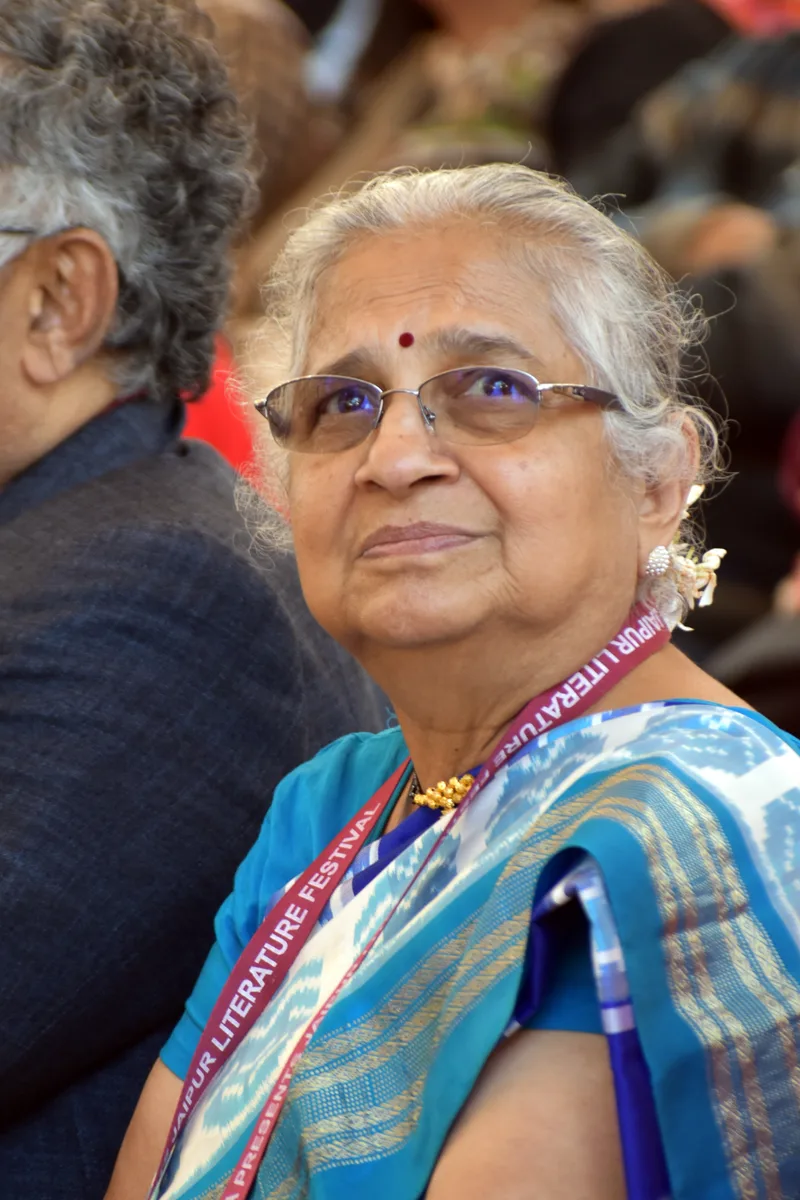
Sudha Murty studied in a Kannada-medium school, struggled with English in engineering college, and wrote her first English book only after she turned 50. Today her books, written in plain and simple language, are read in homes and schools across India. Her journey shows that clear writing is a skill you can start building at any age.
A girl who wanted wings to reach the library
Sudha Murty was born in 1950 in Shiggaon, a small town in north Karnataka. She spent part of her childhood with her maternal grandmother, and she has said that her grandparents told her many of the stories she later retold for children.
Books were special in her home. She told Gulf News that until she graduated, books were the only gifts her family gave her. As a child, she once told her grandfather that if she had a pair of wings, she would fly to the nearest library.
She studied in a Kannada-medium school up to Class 10 and became comfortable in English only in her teens. When she went to engineering college, where classes were taught in English, she found the lessons hard to follow at first. She still did very well, and later passed both her graduation and her master's with gold medals.
“Sensitivity helps you write better.”
— Sudha Murty, via Gulf News
One postcard that opened a door
After her engineering degree, she joined the Indian Institute of Science (IISc) in Bangalore for a master's in computer science. One day she saw a job advertisement from TELCO, the company now called Tata Motors, on the notice board. It said women candidates need not apply.
She already had a scholarship to study in the United States and was not looking for a job. But she felt the line was unfair, and she wrote a postcard to the chairman, J. R. D. Tata, to say so. Within about ten days, TELCO sent her a telegram inviting her for an interview in Pune and offered to pay her travel costs. She got the job and became the company's first woman engineer.
In Pune she met N. R. Narayana Murthy, whom she later married. When he wanted to start his own software company, she gave him 10,000 rupees from her savings. That company became Infosys. In 1996 she started the Infosys Foundation, a charity that supports schools, hospitals, libraries and other public work.
Writing in Kannada first, English after 50
Her first novel was published in Kannada, her mother tongue, in 1979, when she was 29. For more than twenty years after that, she wrote mainly in Kannada.
She did not think her English was good enough for books. It was the journalist T. J. S. George, then a senior editor at the Indian Express, who encouraged her to write in English. Her first English book came out after she turned 50. Wise and Otherwise became one of her best-known English titles.
Many more followed, including How I Taught My Grandmother to Read, Dollar Bahu, Grandma's Bag of Stories and Three Thousand Stitches. The title story of How I Taught My Grandmother to Read grew out of her own childhood with her grandmother, and it has been translated into more than 15 languages.
A writer read across India
According to her publisher, Penguin, she has written more than 300 titles in English and Kannada. Her books have been translated into all the major Indian languages and have sold more than 60 lakh copies.
Her honours include the Padma Shri and the R. K. Narayan Award for literature in 2006, and the Padma Bhushan and the Sahitya Akademi's Bal Sahitya Puraskar for children's writing in 2023. On 8 March 2024, President Droupadi Murmu nominated her to the Rajya Sabha.
Much of her material comes from everyday life. Her travels and her work with the Infosys Foundation gave her many of the people and incidents that appear in her stories.
The skills and habits that made the difference
She collects stories from life. She told Gulf News that when she comes across something interesting, she keeps it in her memory and lets it grow. For a novel, she may think about the characters for years, but the actual writing then takes her about 20 days.
She keeps it simple. A review in The Book Review notes that her children's stories have little description and few long conversations, so the plot keeps moving. She talks to young readers at their level, like a friend, instead of preaching.
She shows values instead of lecturing. In her stories, unkind or greedy characters change because of what happens to them, so the lesson comes through the story itself.
She asks her readers. The same review reports that she shares her drafts with children for honest feedback before sending them to publishers, and changes them based on what they say.
What you can learn from Sudha Murtyइस कहानी से आप क्या सीख सकते हैं
- Start in the language you think inSudha Murty wrote in Kannada for over twenty years before English. Write your first drafts in the language that feels natural, and build your English or Hindi alongside.
- Write down what you noticeHer stories come from people she met and places she visited. Keep a small notebook or phone note of interesting incidents, and turn one into a short piece every week.
- Use short, plain sentencesHer books are loved because they are easy to read. Cut long descriptions and difficult words, and check that a younger sibling could follow your piece.
- Show, don't preachShe lets the story carry the message. Instead of telling readers what to think, describe what happened and let them reach the point themselves.
- Get feedback from real readersShe tests drafts on children before publishing. Share your writing with a friend or family member, ask where they got bored or confused, and fix those parts.
How you can build this skill on YUNOVAYUNOVA पर आप यह skill कैसे सीख सकते हैं
Nobody becomes Sudha Murty from one course. But the habits behind her books, noticing small things, writing in plain words and improving drafts with feedback, are the same ones every writer can practise. On YUNOVA you can learn content writing step by step in Hindi, at your own pace, and build a skill that is useful in studies, work and everyday life.
हिंदी में सारांश
सुधा मूर्ति ने कन्नड़ माध्यम के स्कूल में पढ़ाई की और इंजीनियरिंग कॉलेज में शुरुआत में उन्हें अंग्रेज़ी में मुश्किल हुई। उन्होंने अपना पहला उपन्यास 29 साल की उम्र में कन्नड़ में लिखा और पहली अंग्रेज़ी किताब 50 साल के बाद। उनकी किताबें सरल भाषा में हैं और रोज़मर्रा की ज़िंदगी के लोगों और घटनाओं से आती हैं। वे अपने ड्राफ़्ट बच्चों को पढ़ाकर उनकी राय लेती हैं। आप भी YUNOVA पर Content Writing हिंदी में, अपनी रफ़्तार से सीख सकते हैं।
Sourcesस्रोत
- Award-winning author and philanthropist Sudha Murty believes in leading by example, Gulf News (accessed 17 October 2026)
- Know Sudha Murthy and how a postcard to JRD Tata changed her life, Onmanorama (Malayala Manorama) (accessed 17 October 2026)
- The Magic Drum and Other Favourite Stories (author page), Penguin Random House India (accessed 17 October 2026)
- Author and philanthropist Sudha Murty nominated to Rajya Sabha, Scroll.in (accessed 17 October 2026)
- Grandpa's Bag of Stories (review by Indira Ananthakrishnan), The Book Review (accessed 17 October 2026)
- Sudha Murty, Wikipedia (accessed 17 October 2026)
Written by YUNOVA from public sources. Sudha Murty is not affiliated with and does not endorse YUNOVA.
More storiesऔर कहानियाँ
- Amartya Sen: from Santiniketan to the Nobel, economics for human welfareEconomist and philosopher, 1998 Nobel laureate in economic sciences
- Andrew Ng: the professor who put machine learning online for everyoneCo-founder of Coursera and founding lead of Google Brain
- Andy Jassy: the marketing manager who built Amazon Web ServicesFounding leader of Amazon Web Services and Amazon's CEO