

YUNOVA Stories · Technology
Sundar Pichai: from a Chennai flat to leading Google
Sundar Pichai · CEO of Google and Alphabet
Written by YUNOVA from public sources. Sundar Pichai is not affiliated with and does not endorse YUNOVA.यह कहानी YUNOVA ने public sources से लिखी है। इसमें बताए गए व्यक्ति YUNOVA से जुड़े नहीं हैं और YUNOVA का समर्थन नहीं करते।
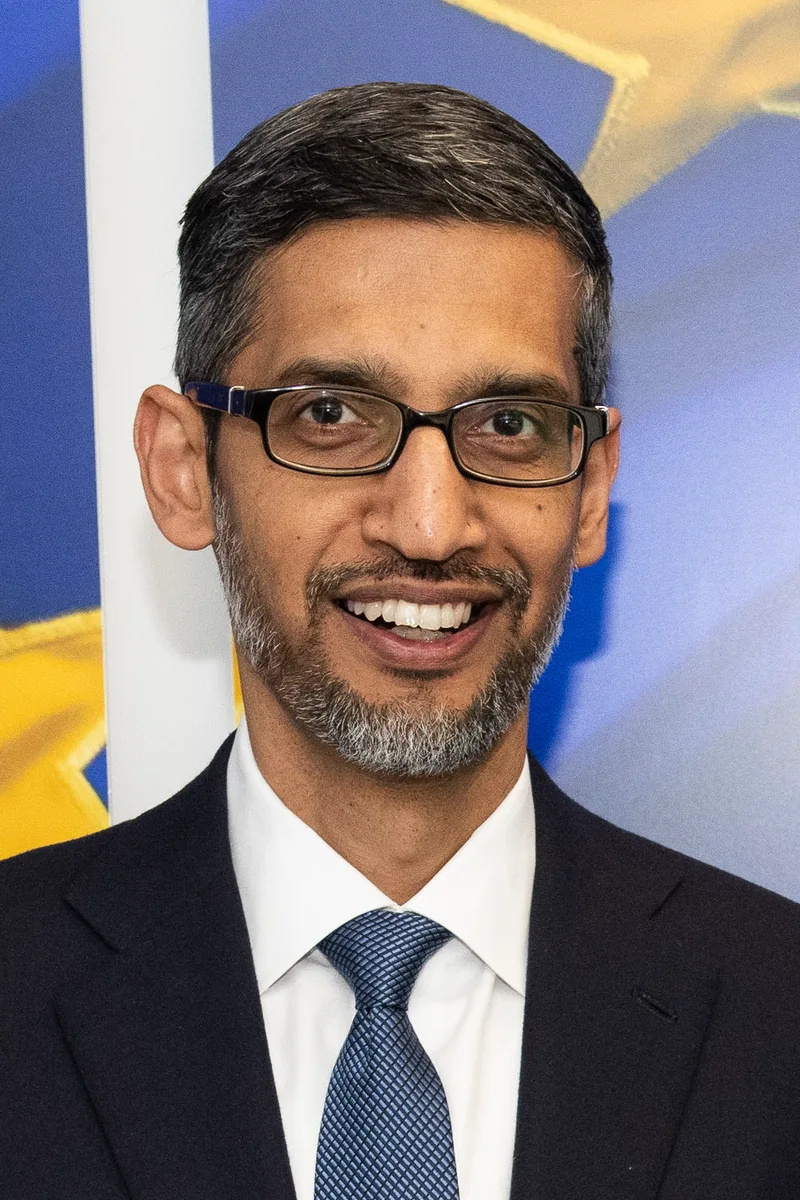
Sundar Pichai's family got their first telephone when he was about ten, and he did not have regular access to a computer until he went to the United States for his master's. He studied metallurgy, not computer science. Curiosity, hard work and an open mind took him from a two-room flat in Chennai to the top job at Google.
A curious boy in a two-room flat
Sundar Pichai was born in Madurai, Tamil Nadu, in 1972 and grew up in Chennai. His family lived in a small two-room apartment, and he and his younger brother slept in the living room. His father, Regunatha Pichai, was an electrical engineer at the British company GEC. His mother worked for a while as a stenographer.
There was not much technology at home. In his 2020 message to graduating students, he said the family got their first telephone when he was about ten, and their television showed only one channel. A Deccan Chronicle report says that as a child he was curious about his father's work, and that curiosity drew him towards technology.
His parents put their savings into their children's education. When he received the Padma Bhushan in 2022, he said he grew up in a family that valued learning and knowledge, and that his parents made sacrifices so he could follow his interests.
He studied at Jawahar Vidyalaya in Ashok Nagar and at Vana Vani school on the IIT Madras campus, where he finished Class 12.
“Don't lose that impatience. It will create the next technology revolution.”
— Sundar Pichai, via Google (The Keyword)
Topping the class at IIT Kharagpur
In 1989 he cleared the IIT entrance exam and joined IIT Kharagpur to study metallurgical engineering. One of his teachers, Professor Sanat Kumar Roy, later described him as a quiet, calm student who was very bright but never showed off.
From his second year he took a strong interest in electronic materials, the materials used to make electronic chips and devices. According to Professor Roy, he was the only student in his batch to choose that specialisation, and he wrote his final-year thesis on it. He graduated in 1993 as the topper of his class and received the Bidhan Chandra Roy Memorial silver medal.
A costly ticket and a first real computer
He won a scholarship to study materials science at Stanford University in the United States. His father tried to take a loan for the plane ticket, but it did not come through, so the family used its savings. Sundar has said the ticket cost his father about a year's salary, and it was his first time on a plane.
Life in California was hard at first. A phone call home cost more than two dollars a minute, and a backpack cost as much as his father earned in a month. He missed his family and friends.
But Stanford gave him something new: a computer he could use whenever he wanted, at a time when the internet was just starting to spread. Computing became the bright spot of those years. He later said that if he had stayed on in graduate school, he would probably have a PhD. Instead, he moved into the technology industry.
From Toolbar to CEO
He began his career at Applied Materials, an American technology company. Later he earned an MBA from the Wharton School and worked at the consulting firm McKinsey.
He joined Google in 2004, where his early work was on the Google Toolbar, a small add-on for web browsers. He went on to lead product work on Chrome, the Google browser launched in 2008. In 2013 he also took charge of Android, the operating system used on a huge number of smartphones.
In August 2015 he became the CEO of Google. In December 2019 he also became CEO of Alphabet, Google's parent company. In their letter announcing the change, co-founders Larry Page and Sergey Brin said they had worked closely with him for 15 years. In 2022 the Government of India awarded him the Padma Bhushan, which he received from India's ambassador in San Francisco.
The skills and habits that made the difference
Curiosity came early. Even with very little technology at home, he was interested in how his father's work and new devices changed daily life. He has said that each new technology that reached his home made life better, and that this is what led him to Google.
He went deep into one area. At IIT he chose a specialisation nobody else in his batch picked and wrote his thesis on it, while finishing at the top of his class.
He kept an open mind. He trained as a metallurgical engineer, discovered computing in his twenties, and changed direction instead of sticking to the path he started on. In his 2020 message he named a deep passion for technology and an open mind as what carried him forward.
He stayed humble. His professor remembered a student who did not show off, and Google's founders praised the humility he brought to his work.
What you can learn from Sundar Pichaiइस कहानी से आप क्या सीख सकते हैं
- Start with what you haveSundar did not use a computer regularly until his twenties. If you have only a phone or a shared laptop, you can still start learning how code works today.
- Ask how things workHis interest in technology began with curiosity about his father's work and the devices at home. Pick one app you use daily and try to learn what it does behind the screen.
- Go deep, not just wideAt IIT he focused on one specialisation and wrote his thesis on it. Choose one programming topic and practise it properly before jumping to the next.
- It is never too late to switchHe studied metallurgy and then moved into technology. Your degree does not have to decide what you learn next.
- Stay humble and keep learningHis teachers and colleagues remember his humility. Ask questions, accept that you will make mistakes, and keep improving.
How you can build this skill on YUNOVAYUNOVA पर आप यह skill कैसे सीख सकते हैं
Nobody becomes Sundar Pichai from one course. But the basics of programming, how a computer follows instructions, how to break a problem into steps, and how to fix mistakes, are where every coder begins. On YUNOVA you can learn programming fundamentals step by step in Hindi, at your own pace, even if you have never written a line of code before.
हिंदी में सारांश
सुंदर पिचाई चेन्नई के एक छोटे से दो कमरों वाले घर में बड़े हुए, और उनके घर में पहला टेलीफ़ोन तब आया जब वे लगभग दस साल के थे। उन्होंने IIT खड़गपुर से metallurgical engineering पढ़ी और अपनी क्लास में टॉप किया। कंप्यूटर का नियमित इस्तेमाल उन्हें पहली बार अमेरिका में Stanford पहुँचकर मिला। जिज्ञासा, मेहनत और खुले मन के साथ वे Google के CEO बने। आप भी YUNOVA पर Programming की बुनियादी बातें हिंदी में, अपनी रफ़्तार से सीख सकते हैं।
Sourcesस्रोत
- Sundar Pichai's message to the Class of 2020, Google (The Keyword) (accessed 17 October 2026)
- Like father, like son, Deccan Chronicle (accessed 17 October 2026)
- Pichai a brilliant student who never showed off: IIT professor, IANS (via ap7am) (accessed 17 October 2026)
- 'India is a part of me,' says Google CEO Sundar Pichai on receiving Padma Bhushan, Business Today (accessed 17 October 2026)
- A letter from Larry and Sergey, Google (The Keyword) (accessed 17 October 2026)
- Sundar Pichai profile, Global Indian (accessed 17 October 2026)
- Sundar Pichai, Wikipedia (accessed 17 October 2026)
Written by YUNOVA from public sources. Sundar Pichai is not affiliated with and does not endorse YUNOVA.
More storiesऔर कहानियाँ
- Amartya Sen: from Santiniketan to the Nobel, economics for human welfareEconomist and philosopher, 1998 Nobel laureate in economic sciences
- Andrew Ng: the professor who put machine learning online for everyoneCo-founder of Coursera and founding lead of Google Brain
- Andy Jassy: the marketing manager who built Amazon Web ServicesFounding leader of Amazon Web Services and Amazon's CEO